
The European Sol2H2O project, coordinated by the University of Évora, has successfully concluded after three years of activities focused on advancing solar-driven technologies for water production and treatment. The project formally ended in November 2025, marking the completion of a collaborative effort aimed at strengthening research excellence in the water-energy nexus.
Funded by the European Commission under the Horizon Europe programme within the Widening Twinning scheme, Sol2H2O ran from December 2022 to November 2025. The consortium was led by the University of Évora and included three leading European research partners: the CIEMAT (Spain), the Instituto Tecnológico de Canarias, and the University of Palermo.
The main objective of the project was to strengthen scientific excellence and innovation capacity in solar-driven water production and treatment technologies, addressing key challenges related to desalination sustainability, including high energy demand and the environmental impact of brine discharge. The project explored integrated solutions combining solar energy with advanced desalination and brine valorisation concepts, aiming to develop circular systems capable of producing fresh water while recovering valuable resources from waste streams.
A central research component of the project was the development of an innovative solar-powered desalination pilot system designed to increase water recovery and approach zero-liquid-discharge operation. The prototype integrates technologies such as photovoltaic-powered reverse osmosis, membrane distillation and advanced crystallization processes, enabling recovery rates significantly higher than conventional desalination systems.
Throughout its implementation, Sol2H2O promoted extensive international collaboration, training activities and knowledge exchange between partners. Particular emphasis was placed on capacity building and career development for young researchers and candidate young researchers, including mobility activities, technical training and involvement in joint research initiatives. These exchanges strengthened the scientific skills of early-career researchers and fostered knowledge transfer between institutions.
The project also contributed to strengthening links between academia and industry, promoting collaboration with research institutions and companies working on water treatment and membrane technologies, and increasing the visibility of research carried out at the University of Évora in international scientific and technological forums.
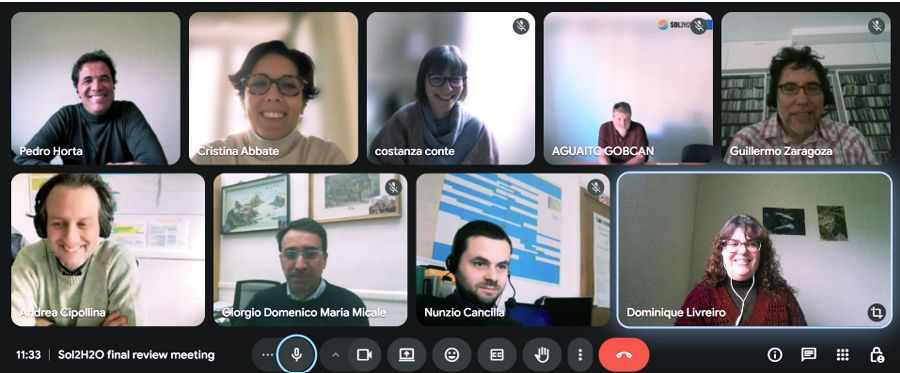
The final project meeting, held in February 2026, marked the closure activity of the project. According to the consortium team, the evaluation process was successfully completed, with the technical report approved. The feedback from the Project Officer from the European Commission and the auditor was very positive, highlighting the achievement of the project’s objectives, the scientific quality of the results, and the impact of the activities carried out.
With the conclusion of Sol2H2O, the SOL4R Unit (Renewable Energies Chair of the University of Évora) further reinforces its role in advancing research at the intersection of solar energy and sustainable water technologies, consolidating its scientific capacity and opening new opportunities for future European collaborations addressing the global challenges of water scarcity and the energy transition.